
How to play Chinese Checkers
There are only two moves, a step and a jump. Here is everything else you need to know.
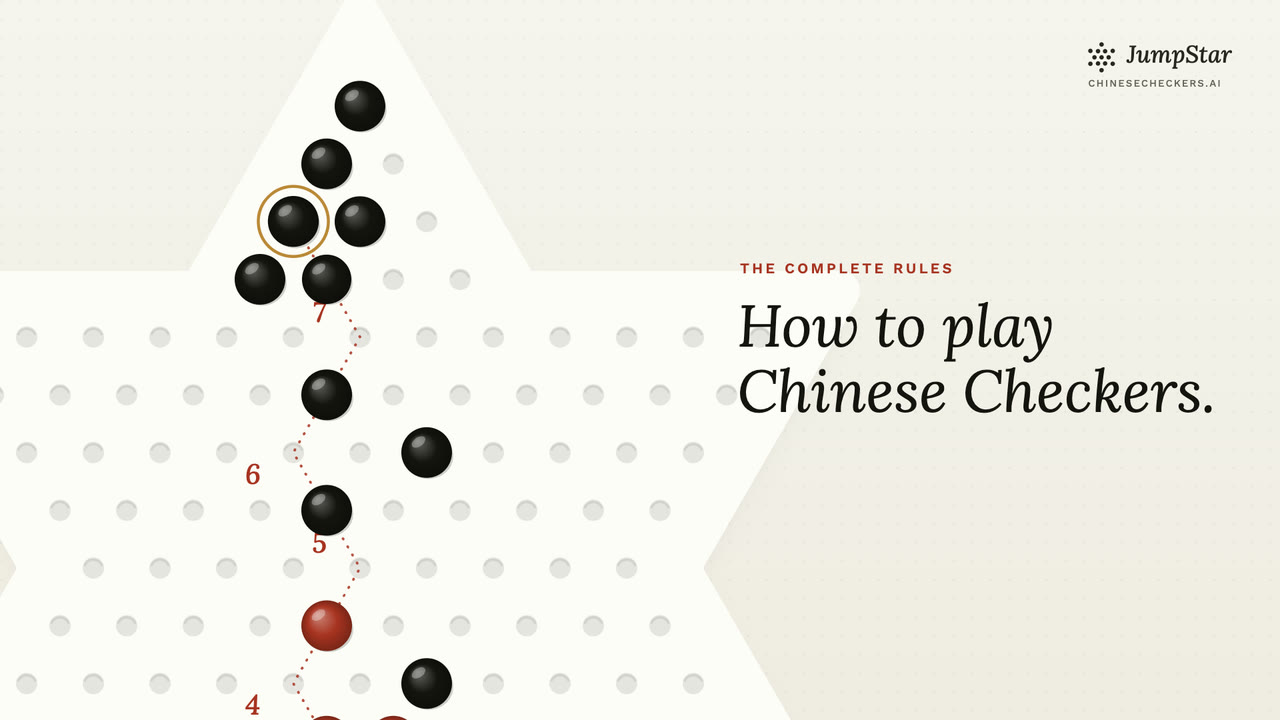
Chinese Checkers is a race for two, three, four, or six players. Everyone starts with ten pieces in one point of the star, and the first to move all ten into the point opposite wins. Nothing is ever captured.
01
Know where you're going
In a two-player game you start at opposite ends, and each of you races to the triangle the other one started in.
Pieces can move in any direction, through any open hole. You win when all ten of yours are in the opposite triangle, in any order.
02
A step moves one hole
Move one piece into any empty hole next to it. That's your whole turn.
03
A jump goes over one piece
If a piece next to yours has an empty hole right behind it, you can jump over it into that hole. It can be your piece or anyone else's, and it stays where it is.
You can't jump over a gap, over two pieces at once, or into a hole that's taken.
04
Keep jumping if you can
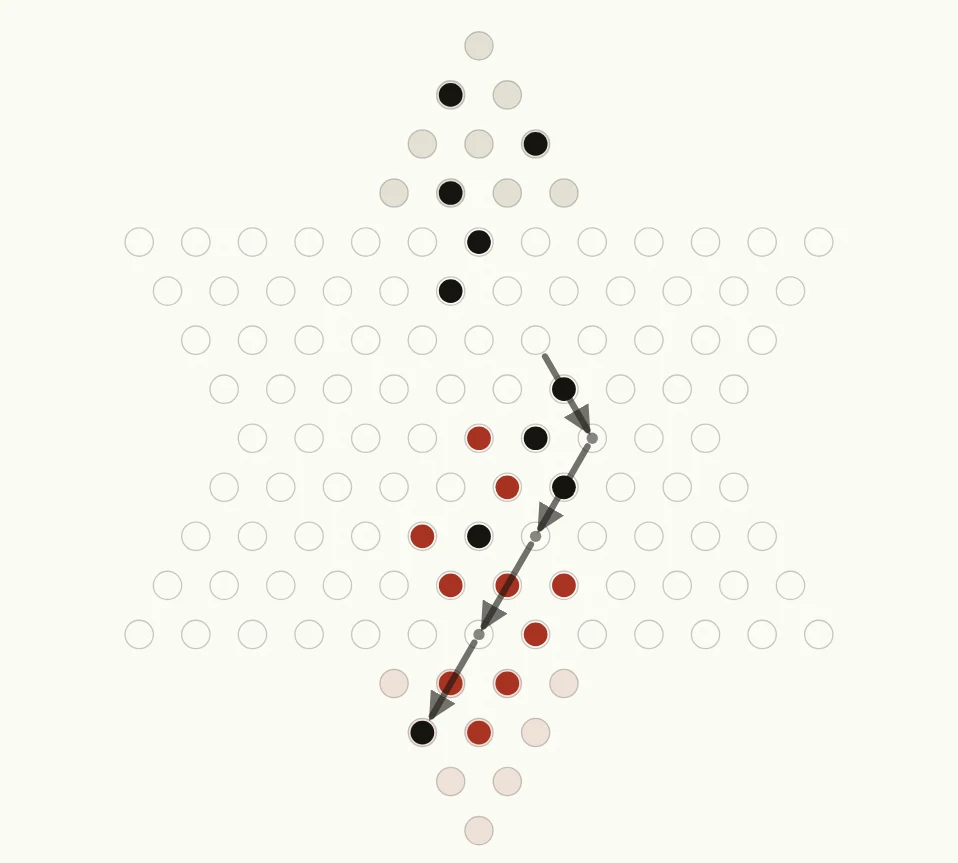
After you land, if the same piece has another jump, it can take it, and the next one, turning wherever it likes. You can stop after any landing, but you can't switch to a different piece.
The board shows a real four-jump move from a JumpStar game. Watch the whole game.
05
Setting up
With two players, use opposite points, so each of you starts in the other's goal.
Three players
Leave an empty point between each pair of players.
Four players
Use two pairs of opposite points and leave two neighboring points empty.
Six players
Every point is filled. Five isn't a standard count, because one player's goal would start empty while everyone else's starts full.
06
The tenth piece wins
The game ends when one player has all ten pieces in the opposite triangle. In the position shown, nine are already in, and one step finishes it.
With more than two players, the others can keep playing for the remaining places. House rules differ on what happens if someone parks a piece in your goal so you can't finish, so agree before you start. The online game handles it for you.
Common questions
Can you move backward or sideways?
Yes. Steps and jumps can go in any of the six directions. Moving back is sometimes the best way to set up a longer jump on your next turn.
Can you jump more than once in a turn?
Yes, as many times in a row as the board allows, all with the same piece. You can stop after any landing.
Do you have to jump when you can?
No. You can step instead, or stop a chain of jumps early.
Can you jump over two pieces at once?
No. Each jump goes over exactly one piece. A long move is several jumps in a row.
Are jumped pieces captured?
No. Every piece stays on the board, and there are no kings.
Can you step and then jump in the same turn?
No. A turn is either one step or a chain of jumps, and it uses one piece.
Can two people play Chinese Checkers?
Yes. Put the two players in opposite points. It's the best way to learn.
A note on the name
Chinese Checkers isn't Chinese, and it isn't a kind of checkers. It comes from Stern-Halma, a German game from 1892, and the name came later as marketing.
Sources: modern ten-piece instructions, Parker Brothers rules from 1938, and The Strong Museum's game history.
The easiest way to learn is to play. The online board shows every legal move as you go. Play Chinese Checkers online free.