
Strategy guide
How to win at Chinese Checkers
Two-player strategy, shown on real games played by JumpStar, our AI.
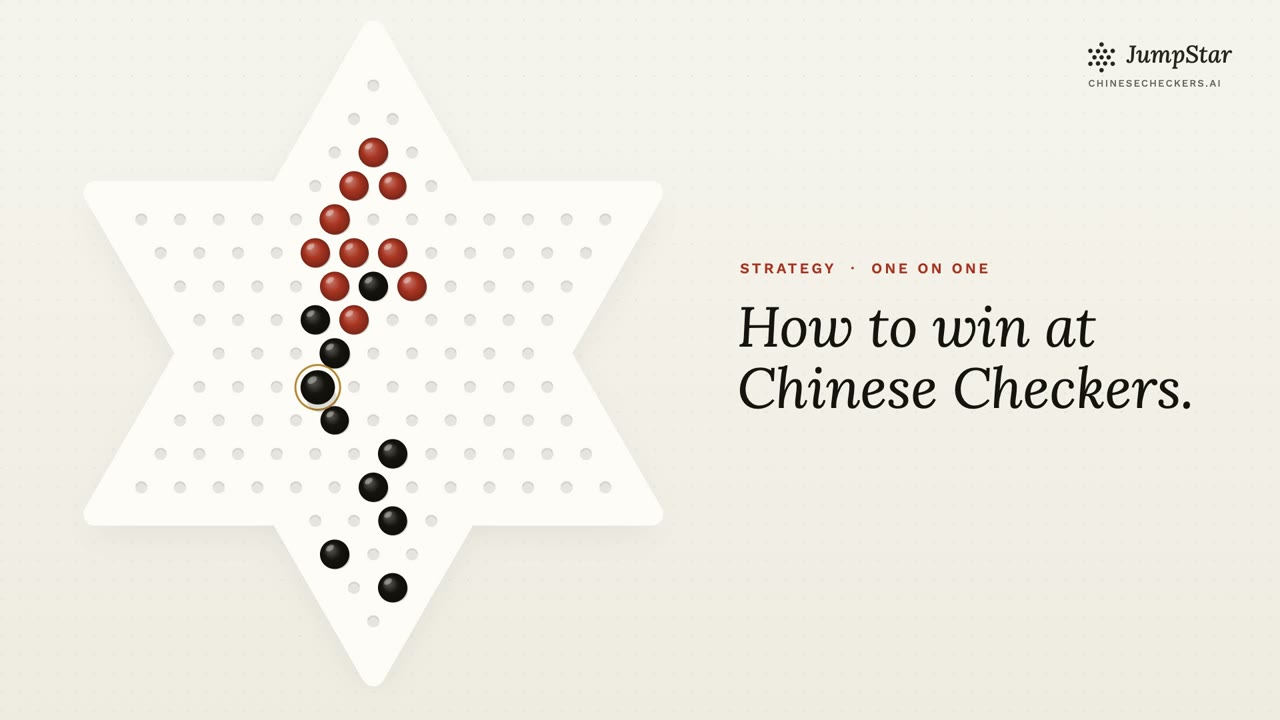
Most of the boards below come from one complete JumpStar game you can replay move by move. The rest come from JumpStar's self-play games, picked because each one shows a single idea clearly.
1. Think in turns saved, not holes gained
Chinese Checkers is a race, so what you're really spending is turns. A step moves one marble one hole. A good chain of jumps can move a marble six or eight rows, and it also costs one turn. So when you move, think about how many turns that move saved you, not just how far it went.
Before every move, ask
- Does this build my road?
- Does it build theirs?
- Who's ahead right now?
- Is anyone getting left behind?
2. Open from the corner, then build a road
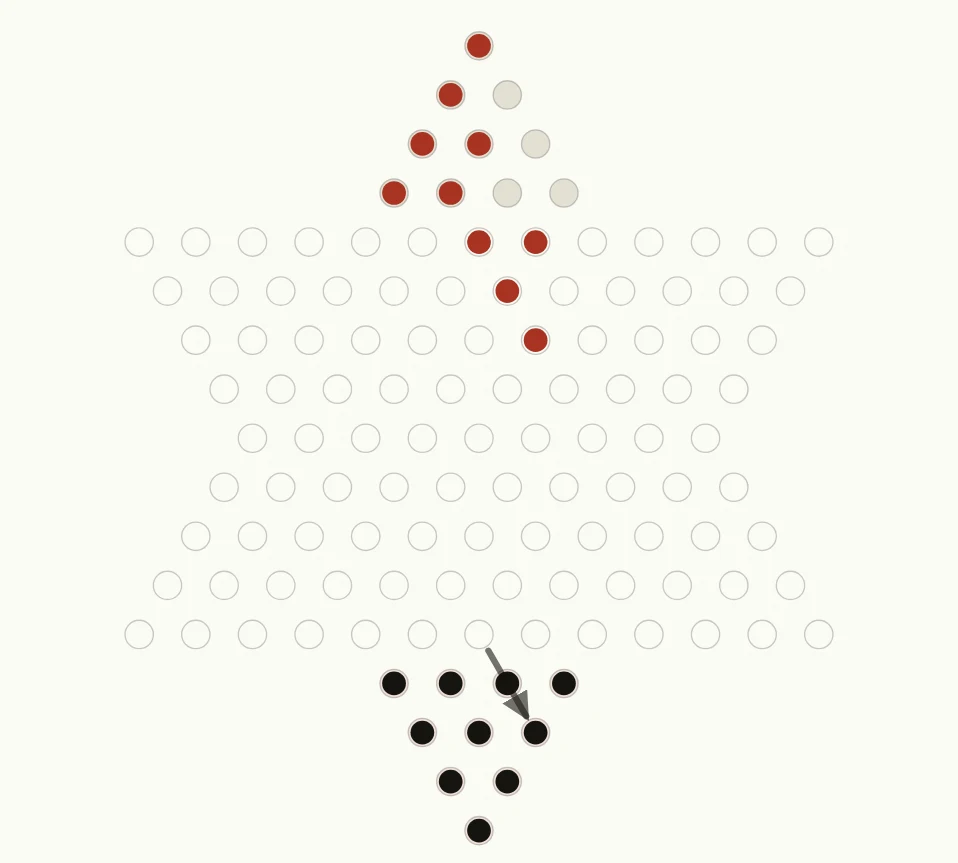
Long chains need setting up, and the setup starts on move one. We checked 833 games from recent JumpStar versions that began from the normal starting position, and every one opened the same way: step the marble on a front corner of the triangle forward one hole. It looks like nothing, but it opens a gap. On the next turn, the marble behind it jumps twice through that gap and lands out in the board.
From there, keep adding to the same line. Marbles spaced with one empty hole between them form a road: each one gives the marble behind it something to jump over, so the back marble can jump all the way past the front. A marble pushed far ahead on its own does the opposite. Nothing near it can be jumped, and it's too far ahead for anything behind it to use.
Here are the first eight moves of the featured game. Step through them and watch how each jump uses the line and adds to it.
Moves 1-8 of the featured game
| # | Player | Kind | Move |
|---|
3. Use their marbles too
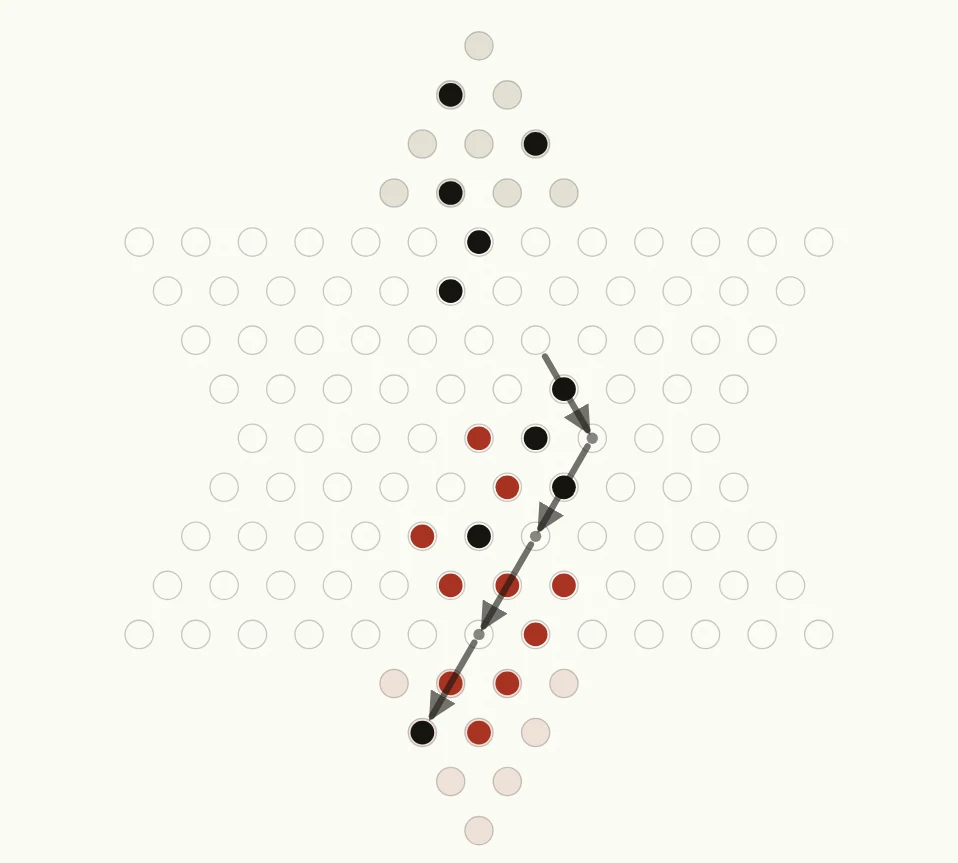
In a two-player game your opponent's marbles are heading through the same middle of the board, straight at you. Any marble can be jumped, yours or theirs, so their pieces can be part of your road too. When you look for a long jump, look at the empty holes behind the marbles. Those landing holes decide where a chain can go.
4. Watch where you land
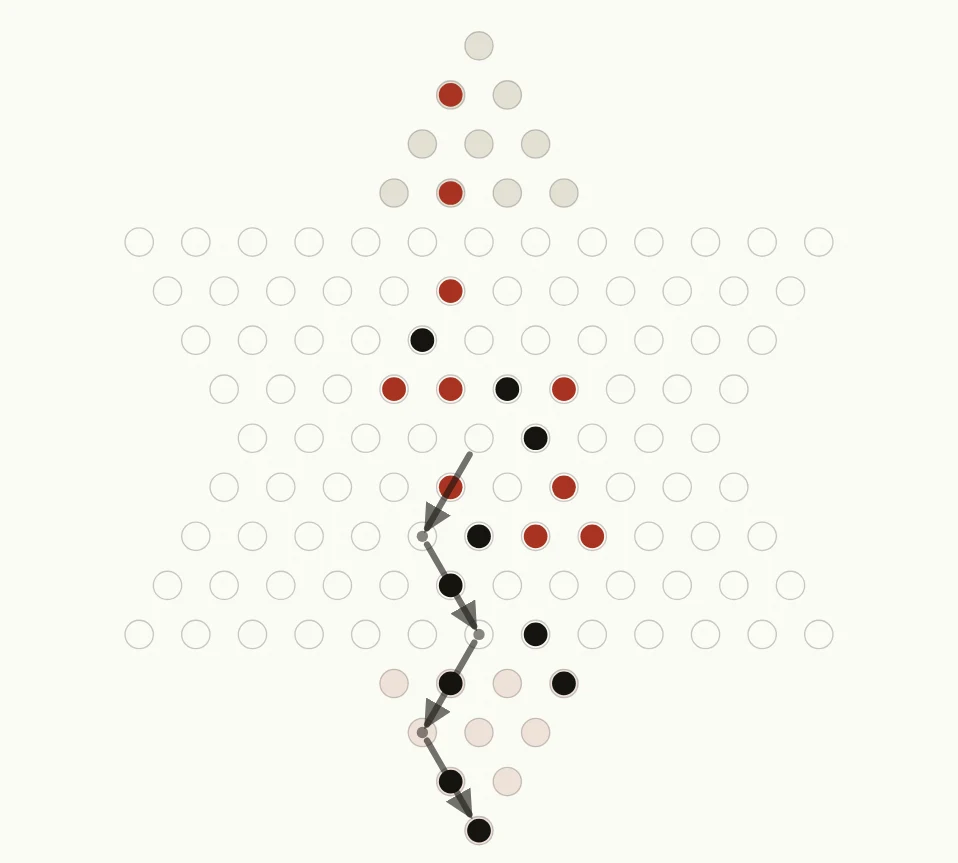
This works for your opponent too. Every marble you leave in the middle is one they can jump over, so a landing hole is never only yours. Before a long jump, look at where you'll end up and what that marble lets them do next.
A JumpStar self-play game
5. Block the landing, not the marble
If landing holes are what make a chain work, they're also how you stop one. You don't need to block the marble that's about to jump. Step one of your marbles into a hole the chain needs to land in, and the rest of the chain is gone.
A JumpStar self-play game
6. Count the race before you block
Blocking costs you a turn you didn't use to move toward your own goal, so it pays to know who's winning first. A simple way to keep score: count how many rows each of your marbles still has to travel to reach your goal triangle, and add them up. Then do the same for your opponent. It's a rough count, because one jump can cover several rows, but it's close enough to tell you who's ahead.
- Ahead? Race. You don't need to block, and every block slows you down.
- Behind? Block. Racing alone probably won't catch them.
- A block that costs them one turn and costs you one turn isn't worth it. Race instead.
7. Leave no marble behind
One of the most painful ways to lose a game you were winning is to send nine marbles forward and leave one at home. With nothing left near it to jump over, that last marble has to step, turn after turn.
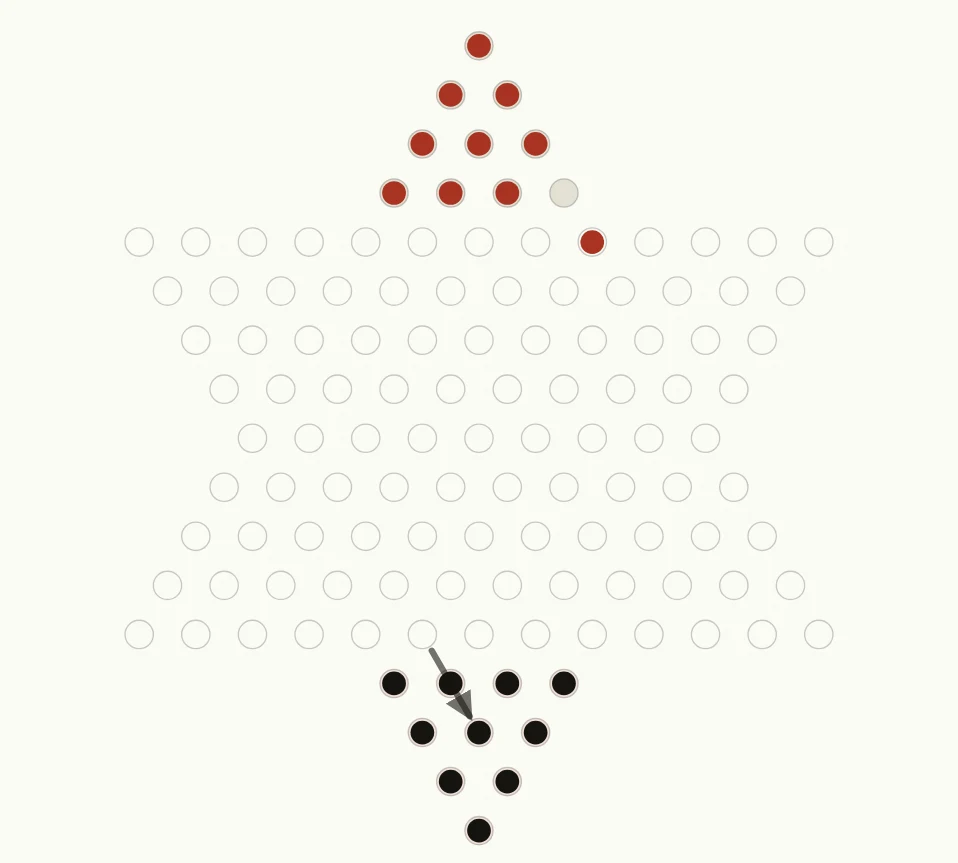
After each move, find the piece farthest from the goal. Can it use your road next turn? If not, bring it forward while it still has marbles to jump over.
8. Fill the back of the goal first
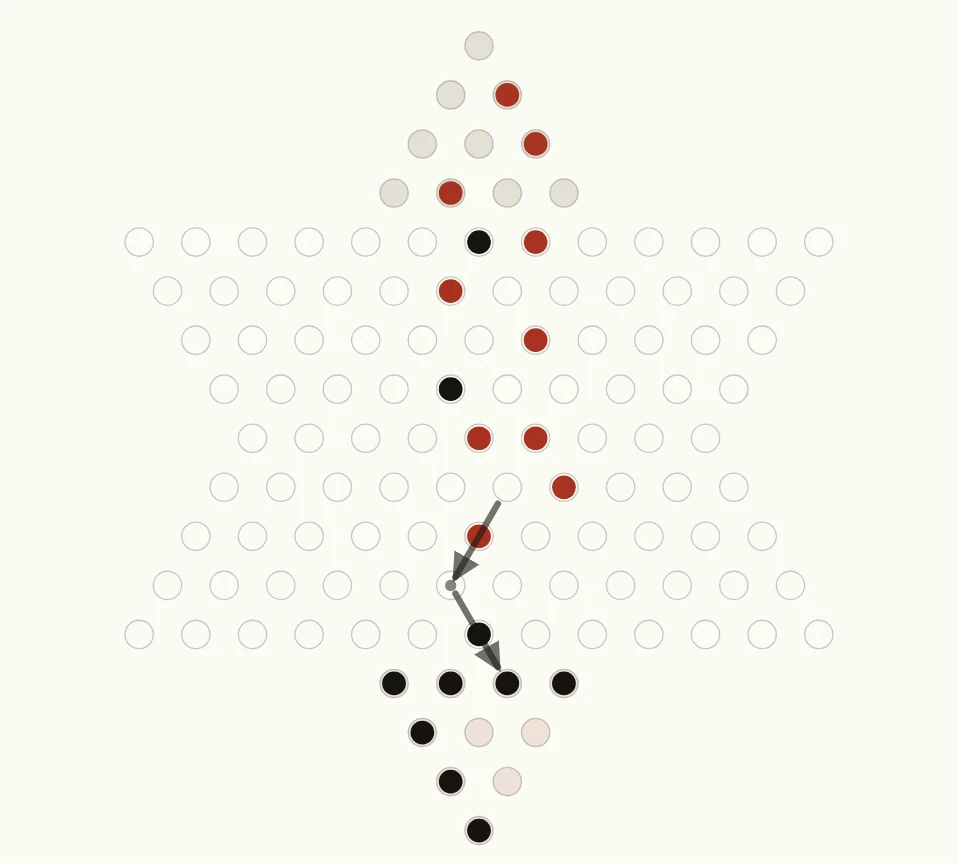
The front of the goal triangle is easy to reach and easy to clog. Fill those holes too early and the marbles still coming have nowhere good to land. Get to the back holes while the board is still open.
How strategy changes with more players
In two-player Chinese Checkers, every block has one target. On three-, four-, and six-player boards, the middle can change completely before your next turn. Someone else might extend your road, take your landing hole, or move the marble you were planning to jump.
Keep two possible routes through the middle, and check who moves before you before counting on someone else's marble. Blocking is also worth less, because slowing one opponent just helps everyone else.
Four things to practice
For ten turns, reject the move that advances farthest. Look for the move that creates the most future jumps.
Every ten moves, add up rows to go for both sides and say who's ahead before you choose a move.
After every move, find your last marble and the marble it will jump over next. If there isn't one, fix that first.
After a loss, find the move where your marbles first split apart, and try a few other moves there.
Common questions
What's the best opening in Chinese Checkers?
Start from a front corner. Step the marble on a front corner of your triangle forward one hole, then on your next turn jump the marble behind it through the gap. In 833 games from recent JumpStar versions that started from the normal setup, every one opened this way. After that, keep adding marbles to the same line so later pieces have something to jump over.
How do you block in Chinese Checkers?
Block the landing hole, not the marble. Find the chain of jumps your opponent is setting up and step one of your marbles into a hole that chain needs to land in. The best blocks also move your own marble forward.
How do you know who's winning in Chinese Checkers?
Count rows. For each of your marbles, count how many rows it still has to travel to reach your goal triangle, and add them up. Do the same for your opponent. The smaller total is ahead. It's rough, because one jump can cover several rows, but it's usually close enough to decide your plan.
Should you block or race in Chinese Checkers?
Race when you're ahead and block when you're behind. Every block is a turn you don't spend moving toward your own goal, so it only pays when it costs your opponent more than it costs you.
How do you avoid getting stuck at the end of Chinese Checkers?
Fill the back of your goal triangle first, and don't leave a marble behind. If you fill the front row of the goal early, your last marbles have nowhere good to land; if one marble is left far behind, it has nothing to jump over and has to step all the way home.
Further study
If you want to go deeper, these papers study the game mathematically and computationally.
- The Shortest Game of Chinese Checkers and Related Problems - a mathematical study of minimum-move transfers and cooperative play.
- Chinese Checkers AI research - strategy learning and game-playing methods.
- Efficient Chinese Checkers implementation - board representation and search engineering.
Play free in your browser, then look back through the moves to find where your road broke.
Play Chinese Checkers online